Skip to content

macOS Apps

Articles about OS X applications.

Cancel shell script on remote connect failure

I use a shell script to back up this site (and a variant of the same script to back up the Many Tricks site). I've been using these scripts for over a decade (wow), and though they've evolved, they're still fundamentally the same. (I did switch from cron to launchd for launching them, however.)

While the script typically runs very nicely, I recently noticed that my last backup was from a few weeks ago—uh oh. It didn't take long to figure out what had gone wrong: My ISP changed the hostname of the machine my site runs on, and my script uses ssh, scp and rsync, which connect via the hostname. Unfortunately, the failure mode is silence, because the script runs via a scheduled task. The only way I knew it failed was when I went to check the backup folder. Obviously, something more automatic than that would be desirable.

After much web searching, I couldn't find anything that seeemed like it'd do what I want: An email (and onscreen alert) if my backup failed. I found lots of Unix solutions to send mail using sendmail, but I didn't really want to enable that on my Mac. So I futzed around and built a simple checker that will mail me when it can't reach my web host.

[continue reading…]


How to find modified preference values

My recent tip about using Keyboard Maestro to toggle the visiblity of hidden items in Finder (which turned out to be irrelevant for Sierra users; just hold ⌘⌥.) works by checking a hidden macOS preferences setting. In this case, I checked for the existence of the AppleShowAllFiles key, which let me toggle the visiblity of invisible files based on the result of the check.

Controlling a macro—or a shell script or AppleScript—by checking (visible or hidden) preference values can be very useful. But how do you find out the name of the preference you need to check, and in which domain (preferences file) you'll find it? Hidden prefs are actually easiiest, because the command you use to write them tells you both the preference name and its location. For the hidden files in Finder tip, for instance, the command is this:

defaults write com.apple.Finder AppleShowAllFiles YES

So to check that in a script, I just need to save the results of defaults read com.apple.Finder AppleShowAllFiles into a variable, and I can then take action based on the variable's value. But what about a normal pref, in an application (or in System Preferences)? Say you wanted to check whether Apple's Pages app was set to show its rulers in inches or centimeters…

Why would you want to know this setting? I don't know, I was just trying to come up with an example. Just go with it…

How do you find out the key name associated with that particular preference, and what file it's stored in? I use a couple of different methods.

[continue reading…]


Quickly toggle visibility of invisible files in Finder

Update: If you're running macOS Sierra, ignore the rest of this tip because it's irrelevant! I had no idea Shift-Command-Period would show/hide hidden files directly in Finder in macOS Sierra. Thanks to NaOH for the great tip via the comments!

Basically, if you want to show invisible files in Finder in Sierra, pressing ⇧⌘-Period will toggle them between hidden and visible. Nice! If you're on an earlier version of macOS/OS X, however, you may find the macro version useful for easily showing and hiding hidden files in Finder.

[continue reading…]


Install a cloud driver server of your very own

For many years, Peter and I have managed our shared Many Tricks files via Dropbox. To support Dropbox, we purchased an upgraded plan for $99 a year, which came with 1TB of space. We then used the same login to share the Dropbox folder. We didn't need anywhere near 1TB (we have about 4GB of shared files), but felt it was right to support Dropbox.

While this worked well, and we had no issue paying for it, we had a few concerns—about space, third-party involvement, and something possibly unique to my usage scenario. You can read the details in the remainder of this post, but to make a long story short, I went looking for a replacement. And I found one in Nextcloud. Nextcloud has a commercial product, but it's open source, so you can also install it on your own server, and via many hosting companies that have it preinstalled.

I was able to install it easily with our hosting provider; I had the basic install up and running in under 30 minutes. There are also native clients for Mac, as well as Windows, iOS, and Android. The Finder view with the Mac ap installed (it's an official Finder extension) is very similar to Dropbox or OneDrive or any other cloud client with a Mac app:

For us, Nextcloud has every feature we need for sharing our Many Tricks' files; read on for more detail on why we moved, install and admin, the Mac client, and some closing comments.

[continue reading…]


Color and ‘human readable’ file sizes in Terminal

These are two very old tips, but I'd forgotten about them until recently, when I sent someone a screenshot and they said "Hey, how'd you do that?"

Do what, exactly? This…

The most-obvious thing in that shot is the colored filenames. But notice, too, the file sizes are in a human-readable form. Both of these changes are pretty simple, though you could spend hours playing with colors.

Human-readable output

To get human readable output—not just from ls but also in du, which shows disk space usage—just include an h with the ls command: ls -alh. Instead of raw bytes, the values are converted and marked with trailing B, K, M, etc.

Because I never use ls in its short form, I actually added a line to my .profile (which loads whenever you open a Terminal session) to make this automatic:

alias ls='ls -alh'

You could do the same thing with du, but I rarely use that command, so I didn't bother.

[continue reading…]


Browsers, caches and web page changes

Browsers cache data whenever you load a page. In general, this is a good thing—you'll save data transfer (very important on mobile), and increase speed on any connection if the browser can use data that it's already cached.

But there's one place I hate browser cache: When creating or editing web pages. I'll edit a file, save the changes, upload the new file, load the page…and nothing. So I edit again, repeat, still nothing. Only then do I remember the cache. Argh!

Thankfully, there are ways around (most) cache issues. I do most of my web development in Chrome and Safari; here are the simple tips I use to manage cache in those browsers when developing.

Safari

  • Enable the Developer menu (Prefs > Advanced > Show Develop menu in menu bar).

  • Once enabled, use the Developer menu to easily empty the cache via the Empty Caches menu item, which is bound to the keyboard via ⌘⌥E.

  • Also in the Developer menu, you can completely disable the cache with the Disable Caches menu item. This is what I do when developing—just remember to enable them again when you're done, or you'll find browsing quite slow.

  • To force a single page to completely reload, hold down the Option key and click on the reload icon in the URL bar.

[continue reading…]


Microsoft’s public-by-default file sharing site

This morning on Twitter, I saw that @rosyna had retweeted this tweet from @GossiTheDog:

https://twitter.com/gossithedog/status/845446263244050434

That seemed insanely scary, so I did a quick search on docs.com for password 1I am not revealing anything secret here; the original tweet went to thousands of people, and many have already noted the number of shared password files.. The results were quite shocking—hundreds of files containing full login information to major sites—Apple, AT&T, Facebook, Gmail, Linkedin, Netflix, PayPal, Twitter, etc.

It seems crazy to think that these users are intentionally sharing this information with the world. I wanted to see how it was happening, so I logged into docs.com with my Office365 account to see. I created a simple file to upload as a test. After uploading, you have to set a bunch of options before you save the file; one of the settings is the Visibility, and this is the default setting:

Yes, docs.com defaults any uploaded file to world-visible, "giving it a larger audience." Yikes!

[continue reading…]


Use macOS VMs in VMware Fusion in retina mode

I use VMware Fusion often—I have virtual machines that span Mac OS X 10.6 to macOS 10.12.4 beta. I use the more-recent of these for supporting our customers on older versions of the OS, and keep the really old versions just for nostalgia purposes. (I have a bunch of non-macOS virtual machines, too, but they're not relevant to this tidbit.)

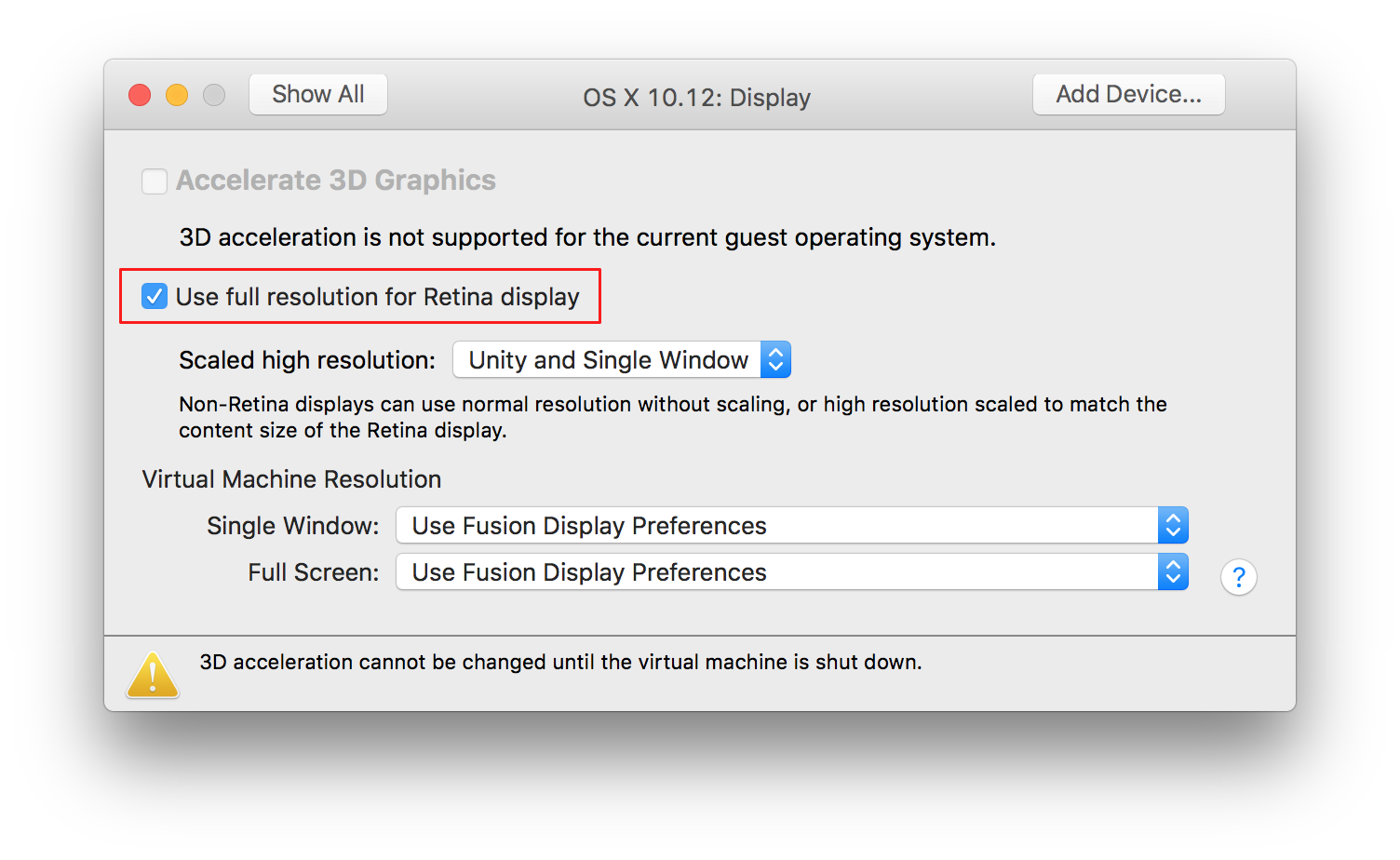
In all the time I've been using Fusion on my retina Macs, though, I've never enabled this setting…

…well, I enabled it once, but turned it off, because the end result was too small to see: In Retina mode, every pixel is an actual pixel, not a doubled pixel. On my 27" iMac, that meant the macOS VM thought it was running at (for example) 2560x1600 instead of a retina resolution of 1280x800. VMware even warns you of this in their Knowledge Base:

Mac OS X running in a virtual machine is limited to an approximate resolution of 2560 x 1600, and treats the display as a standard DPI device. This makes the text and icons to appear small in the OS X interface.

However, today I stumbled across this solution from Patrick Bougie—and it's brilliant in its simplicity. Patrick's post has all the details; I'll reproduce them here in abbreviated form, just in case his page ever vanishes.

[continue reading…]


Edit long Terminal commands in a visual editor

Here's a quickie tip for those of us who occasionally string together complex commands at Terminal's prompt: You may want to add this simple line to your .profile (or whatever init file you use):

set -o vi

What does it do? It tells Unix/Terminal to set the input line editor to vi. When might this be useful? Let's say you've typed a long command, like the one to launch a background screen saver:

/System/Library/Frameworks/ScreenSaver.framework/Resources/ScreenSaverEngine.app/Contents/MacOS/ScreenSaverEngine -module "Arabesque" -background &

Before you hit Return, you notice a couple of typos early in the command. You could use cursor movement keys to move around, of course, but with the above command in place, just press Escape and hit v: The entered command will open for editing in vi. Make your changes, then do the usual :wq vi exit dance, and your edited command will then execute.

Note that if you edit a command but then don't save it (i.e. you press :q!, you may have to hit Return on the command line to get out of an odd "waiting for v to edit" mode. (At least that's the only way I found to return to normal typing.)


An odd fix for ‘jpeg’ vs ‘jpg’ filename extensions

I recently reinstalled macOS Sierra, due to my annoying Bluetooth issues. I hadn't noticed any side effects of the reinstall until I went to save a JPEG image from Acorn.

On save, I noticed that the image's extension was .jpeg rather than what I thought was the usual .jpg. As both of my other Macs save with the .jpg extension, I figured something was messed up on the iMac. So I (of course) tweeted about the issue. A while later, Shawn King replied with this seemingly odd suggestion:

So I tried it, and sure enough, changing the screen capture file format via defaults write com.apple.screencapture type jpg and then restarting the SystemUIServer with killall SystemUIServer changed my default JPEG extension in every app to .jpg.

What's really strange is that I then switched the screenshot format back to png, and the .jpg extension remained. I even went so far as to delete the pref (defaults delete com.apple.screencapture), and still, the extension remains .jpg. So whatever change occurred when switching the default screenshot format, it appears to be permanent.

I tried the same trick for the .tiff extension (which I rarely use, so it doesn't bother me as much), and it sort of worked: Captured screenshots got a .tif extension, but images saved from apps still got the four-letter .tiff extension. Weird.

If anyone knows exactly what's going on with the .jpeg vs. .jpg extension, I'd love to hear the explanation.